Recent Articles
Think-Feel-Eat Episode #19: Self-Integrity I of II (Why We Don’t Do What We Tell Ourselves We Will Do!)
Hi! I'm Donna Reish, IF teacher, weight loss coach, blogger, and half of "The Minus 220 Pound Pair" as my husband and I have lost over 220 pounds together (160 of that in the past couple of years through the Weight Loss Lifestyle habits and strategies I teach!). The...

Think-Feel-Eat Episode #18: Pick-a-Protocol III (of III)
Hi! I'm Donna Reish, IF teacher, weight loss coach, blogger, and half of "The Minus 220 Pound Pair" as my husband and I have lost over 220 pounds together (160 of that in the past couple of years through the Weight Loss Lifestyle habits and strategies I teach!). In...
Think-Feel-Eat Episode #17: Pick-a-Protocol II (of III)
Hi! I'm Donna Reish, IF teacher, weight loss coach, blogger, and half of "The Minus 220 Pound Pair" as my husband and I have lost over 220 pounds together (160 of that in the past couple of years through the Weight Loss Lifestyle habits and strategies I teach!). In...
Think-Feel-Eat Episode #16: Pick-A-Protocol I (of III)
Hi! I'm Donna Reish, IF teacher, weight loss coach, blogger, and half of "The Minus 220 Pound Pair" as my husband and I have lost over 220 pounds together (160 of that in the past couple of years through the Weight Loss Lifestyle habits and strategies I teach!). In...
Weight Loss Lifestyle #63: Macronutrients and Calories
Hi! I'm Donna Reish, IF teacher, weight loss coach, blogger, and half of "The Minus 220 Pound Pair" as my husband and I have lost over 200 pounds together (160 of that in the past couple of years through the Perfect Storm of Weight Loss strategies I teach!). In this...

Think-Feel-Eat Episode #15: Four Food Types (and the 80/20 Food Rule)
Hi! I'm Donna Reish, IF teacher, weight loss coach, blogger, and half of "The Minus 220 Pound Pair" as my husband and I have lost over 220 pounds together (160 of that in the past couple of years through the Weight Loss Lifestyle habits and strategies I teach!). In...
Think-Feel-Eat Episode #14: Foundations of Your Food Protocol Part II
Hi! I'm Donna Reish, IF teacher, weight loss coach, blogger, and half of "The Minus 220 Pound Pair" as my husband and I have lost over 220 pounds together (160 of that in the past couple of years through the Weight Loss Lifestyle habits and strategies I teach!). In...

Think-Feel-Eat Episode #13: Foundations of Your Food Protocol Part I
Hi! I'm Donna Reish, IF teacher, weight loss coach, blogger, and half of "The Minus 220 Pound Pair" as my husband and I have lost over 200 pounds together (160 of that in the past couple of years through the Weight Loss Lifestyle habits and strategies I teach!). In...
Think-Feel-Eat Episode #12: Introducing the Perfect Storm of Weight Loss!
Hi! I'm Donna Reish, IF teacher, weight loss coach, blogger, and half of "The Minus 220 Pound Pair" as my husband and I have lost over 200 pounds together (160 of that in the past couple of years through the Weight Loss Lifestyle habits and strategies I teach!). In...
Think-Feel-Eat Episode #11: Introducing the Eating Protocol
Hi! I'm Donna Reish, IF teacher, weight loss coach, blogger, and half of "The Minus 220 Pound Pair" as my husband and I have lost over 200 pounds together (160 of that in the past couple of years through the Weight Loss Lifestyle habits and strategies I teach!). In...
Think-Feel-Eat #10: Thoughts About Your Thoughts During the Pandemic
Are your “pandemic thoughts” troubling you? Do you see graphics and memes telling you that you should be doing more—you’re homebound after all? Do you see graphics and memes telling you that you should just feel how you feel and not worry about getting anything done?...

Think-Feel-Eat Episode #9: 10 Ways to Sit With/Process Food Urges
Hi! I'm Donna Reish, IF teacher, weight loss coach, blogger, and half of "The Minus 220 Pound Pair" as my husband and I have lost over 200 pounds together (160 of that in the past couple of years through the Weight Loss Lifestyle habits and strategies I teach!). In...
Think-Feel-Eat Episode #8 Urges and Feeling Feelings! Part II of II
Hi! I'm Donna Reish, IF teacher, weight loss coach, blogger, and half of "The Minus 220 Pound Pair" as my husband and I have lost over 200 pounds together (160 of that in the past couple of years through the Weight Loss Lifestyle habits and strategies I teach!). In...
Think-Feel-Eat Episode #7: Urges and Feeling Feelings!
Hi! I'm Donna Reish, IF teacher, weight loss coach, blogger, and half of "The Minus 220 Pound Pair" as my husband and I have lost over 200 pounds together (160 of that in the past couple of years through the Weight Loss Lifestyle habits and strategies I teach!). In...

Think-Feel-Eat Episode #6: Donna’s February Thought Work—and How to Get Your Thought Work Started
This episode digs into what Thought Work is and how to set yourself up to implement ongoing Thought Work for weight loss or any goals you have. It begins with the differences in Thoughts (and Beliefs—and how Beliefs are more difficult to control than simple, fleeting...
Categories





Plexus
Check out the supplements that have changed my life!
Ray & Donna Reish Independent Ambassadors #1382677


Think-Feel-Eat Episode #29: Over-Hunger vs. Over-Desire Part I (of II)
Hi! I’m Donna Reish, IF teacher, weight loss coach, blogger, and half of “The Minus 220 Pound Pair” as my husband and I have lost over 220 pounds together (160 of that in the past couple of years through the Weight Loss Lifestyle habits and strategies I teach!).
In this episode, I present the first of two episodes about Over-Hunger and Over-Desire.
Most of us who have battled with excess weight our entire lives understand that eating too much leads to being overweight. What we often do not fully understand is what causes us to overeat. (I’ve described many aspects of what causes us to overeat in TFE episodes found at donnareish.com/perfectstorm)
There are two over-arching causes of over-eating: over-hunger and over-desire. We often get the two confused, and we often think they are one in the same.
In this two part series, I explain the differences and similarities of the two—and how we can take some steps to counteract both of them.
In this episode, I focus primarily on over-hunger (after a brief introduction to both of them).
Over-hunger is any time we experience hunger that causes us to exceed the amount of food our bodies need at our current weight. (Or when we can’t control our hunger while we are attempting to eat at a lower weight/goal weight.)
Hunger is controlled, in large part, by a hormone called ghrelin. I describe what ghrelin is, how is released, its part in our hunger (and somewhat in satiety), and more.
Then I move into ways we can counteract hunger. There is a long list of these, but one of these is Intermittent Fasting. I describe how we can actually train hunger through a daily time of no food at all and a shorter time in which we eat.
Join me next week as we look at over-desire—and then we learn the things that affect both of these (since there are some overlapping elements).


Think Feel Eat #29: Over-Hunger vs. Over-Desire (I of II)
I. Over-hunger vs Over-desire
A. Differences
1. Over-hunger is when we have true stomach hunger—the “growling ghrelin gremlins” are telling us our food is low. (See later.)
a. At end of our fast
b. When we eat a small amount when we open our eating window and then have hunger soon after.
c. When we haven’t regulated hunger during the fast yet.
d. When we haven’t figured out our best fasting time and we can’t sleep at night because of hunger.
2. Over-desire is when we desire food, often without hunger and usually certain types of food.
a. Has nothing to do with hunger.
b. Can eat these desired foods even if we are full.
c. Usually created by giving in to cravings so frequently or by not controlling seductive foods.
d. Not as affected by fasting as hunger is.
3. Each one affects a different part
a. Over-hunger is affected by satiation—when we are not sated or satiated (i.e. full), we can have more hunger
b. Over-desire is affected by satisfaction—when we are not satisfied with our food choices, we have more desire for certain foods
B. Similarities
1. They both cause the same final outcome: over-eating resulting in weight gain.
2. They can both be controlled quite a bit through strategic actions. (See The Perfect Storm of Weight Loss!)
II. Over-Hunger
A. Growling Ghrelin Gremlins
1. What is Ghrelin?
a. Hormone produced in/released from the gut (and also in smaller amounts from the pancreas and brain)
b. It controls appetite!
c. When stomach is empty, ghrelin is released to tell you that you are hungry
d. Stomach growling is associated with ghrelin
e. Also has roles in growth hormones, insulin secretion, GI motility, blood pressure, and more
2. When is it released?
a. Low blood sugar, low weight (i.e. needing to gain weight), and fasting (or long time since last meal) all cause ghrelin to be released
b. Stomach distension—or food in the stomach—can cause ghrelin to NOT be released
c. Sometimes ghrelin overrides stomach distension!
d. Rises before meals and falls after meals
e. Very sensitive to food intake, so it is increased with dieting
f. Also released in response to stress—which is why people overeat when stressed (and can become a vicious cycle that is hard to stop)
g. Released at typical meal times—clock hunger
h. Released about three hours after last meal (waves of hunger)
i. Not released more and more as time goes on
j. Ghrelin is low in the mornings, so fasting will likely be easier in the mornings than the evenings
B. How can we control hunger?
1. Water—fill that stomach up!
2. Sparkling water/carbonation—bubbles trick ghrelin into thinking we are putting food in it (some have opposite effect with sparkling water)
3. Stomach distensibility—as we shrink our stomach, it will be smaller and less ghrelin will be released
4. Fill stomach with the recommended 6 cups of veggies at or near the beginning of eating window! 3 F’s—fluidy, fluffy, and fibrous
5. Don’t overly restrict calories (increases ghrelin automatically)
6. Eat more fiber (again, filling up the stomach)
7. Eat more protein—research shows it is a satiating macro, empties from stomach over longer period of time, and prolongs feelings of fullness
8. HIIT exercises help manage it
9. Exercise fasted—shown to regulate appetite more than later in the day
10. Sleep—seriously, it helps all hormones level out! 7-9 hours is a good number to shoot for
11. Reduce or control stress (mediation, prayer, journaling, yoga)
12. Eat more real foods—feedback to ghrelin doesn’t work as well with processed foods
13. Since it comes in waves that last about ten minutes, you can time them and watch them disappear with the time!
14. Fast!
i. Eventually, you will solve the hunger problem for at least 15-18 hours a day!
ii. You won’t need to use willpower for hunger!
15. Over-hunger and macro-nutrients+
i. Protein most satiating macronutrient
ii. Fat next to the most
iii. Carbs least—but quick energy
C. Steps
1. Intermittent Fasting Course—first Monday of each month; use code SAVE20 to get $20 off– see you in September!

Think-Feel-Eat Episode #28: Eight Fasting Experts on What Breaks a Fast
Hi! I’m Donna Reish, IF teacher, weight loss coach, blogger, and half of “The Minus 220 Pound Pair” as my husband and I have lost over 220 pounds together (160 of that in the past couple of years through the Weight Loss Lifestyle habits and strategies I teach!).
In this episode, I present some much-needed information on what “breaks the fast”—from eight fasting experts I studied, watched, and listened to.
In lieu of an outline for this episode, I have created a chart that shows what the eight fasting experts that I have studied say about breaking the fast. This is a special episode that I did for my free private FB group and decided it was so needed that I put it into my Think-Feel-Eat episodes for you!
The chart is extremely helpful and thorough (I hope you will print it and study it and follow along with the episode!). But here are some super important points about this topic:
1) All 8 experts say that at the very least an oil (even if it is just CBD oil, which has calories and is a fat) can be consumed, at least in small quantities, during the fasting time. (One says only CBD oil—no other oils?)
2) The research for “breaking the fast” is sketch at best. I have taught about this many places. (Here is one: https://donnareish.com/logical-fallacies-broadcast-54/ ) As a teacher and former high school debate coach, I can’t let this go unmentioned. We have to learn how to discern small, self-reported, short studies from more reliable and robust research! A study that says when sucralose is injected into a mouse’s stomach, this happens, can’t automatically be applied to a person drinking a sweetened drink. (And I do fast pretty clean myself!)
3) The best experts to listen to in this episode are the ones who tell what results you are after through fasting. Period. If you are after weight loss, different things interrupt the fast than if you are after cell rejuvenation/autophagy. It really isn’t accurate to even say “this breaks the fast” without saying “when you are going for…..”
I want so many good things for you! Intermittent fasting has changed our lives. I can’t imagine my husband 120 pounds bigger than he is today (how much he has lost) if I had told him that he couldn’t lose weight or wasn’t really fasting if he continued to drink a non-caloric, sweet-tasting drink during his fast. It breaks my heart that people are giving up on fasting because zealots in FB groups tell them they aren’t really fasting if they have this or that in their coffee! (This all has no bearing on me—diet drinks make me want to eat, and I don’t like coffee!) There are very few fasting experts who say black coffee, plain tea, and water only in the fasting window—surprisingly enough!
So listen and learn what different experts say about consuming drinks during the fast. Very eye opening!
(Don’t forget to get your chart here!)
Blessings!
Donna
P.S. Take my incremental, month-long fasting course to get your fasting on strong! We’ve been at it for 18 and 12 months each—and have lost a LOT of weight and feel great! Intermittentfastingcourse.com
Find all of my episodes, outlines, and articles for my two weekly broadcasts:
(1) Weight Loss Lifestyle broadcast (formerly Donna’s Intermittent Fasting Broadcast)
(2) Think-Feel-Eat broadcast at
Sign up for my free webinar: https://intermittentfastingwebinar.com


Think-Feel-Eat Episode #27: Self-Sabotage III (of III)—More Practical Tips
Hi! I’m Donna Reish, IF teacher, weight loss coach, blogger, and half of “The Minus 220 Pound Pair” as my husband and I have lost over 220 pounds together (160 of that in the past couple of years through the Weight Loss Lifestyle habits and strategies I teach!).
In this episode, I present the final lessons on “self-sabotage”!
In #25, I taught the foundations of self-sabotage from the Think Feel Eat position—our thoughts, our feelings, terminology, and more. (Please start here!)
Last week (TFE 26) I started with several practical tips related to self-sabotage—stress management; purposeful, planned self-care; sleep; ideas for sitting with urges; planning food ahead of time; writing something you want to eat for tomorrow rather than in the moment; creating barriers to hyper-palatable foods; dealing with kids’ foods; and much more.
Today I continue with self-sabotage tips, more practical ways that we can stop ourselves from “knowingly or unknowingly obstructing our progress”!
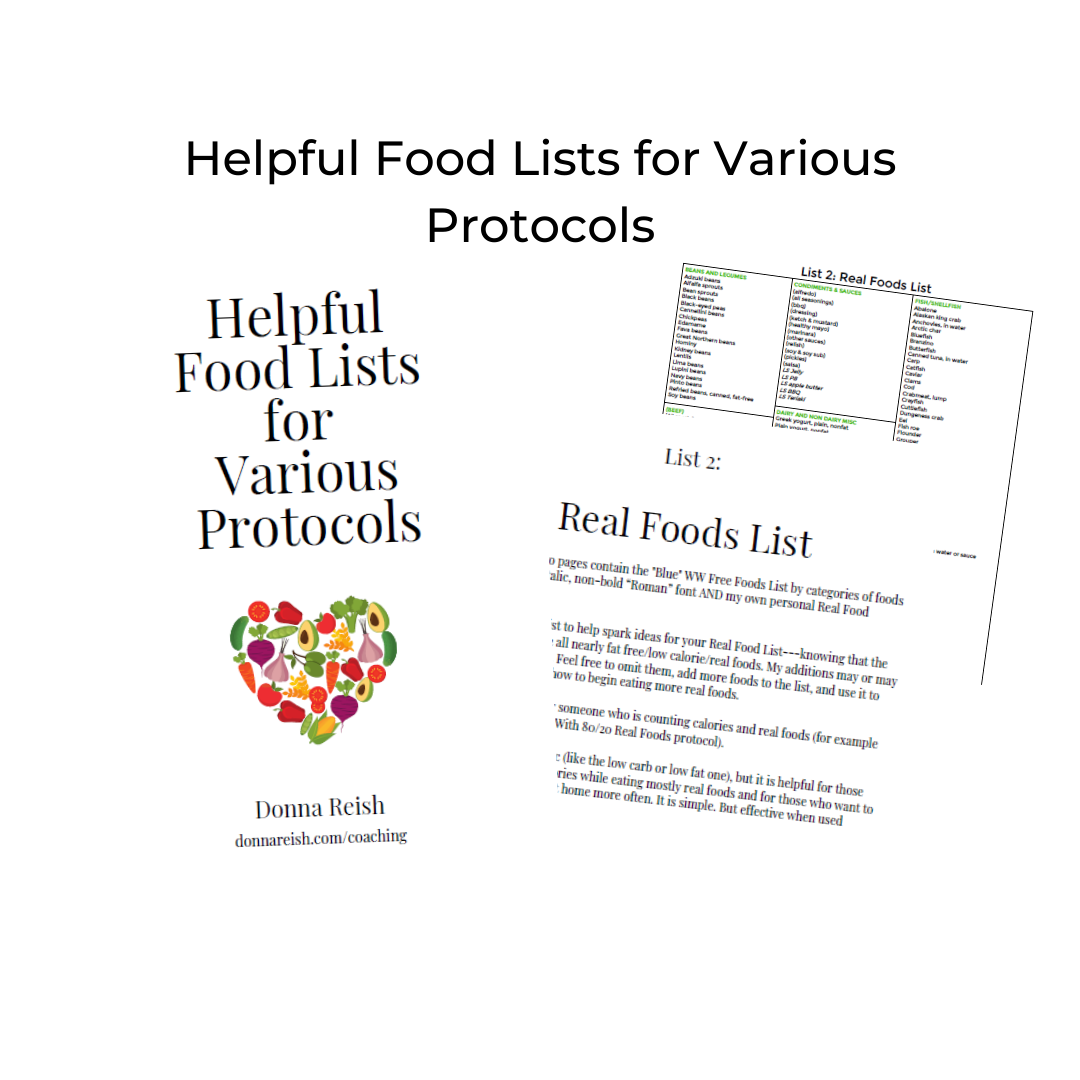
I start with the “buy healthier foods” theory—the pros and cons of this, including the concept of choosing foods you truly like and will eat for the rest of your life (as opposed to “healthier foods” you don’t like. I recommend that you choose a protocol you can live with (see Pick a Protocol!) and have “your foods” (for 80% of the time) and “not your foods” (for the other, carefully planned 20%). I re-introduced my Helpful Foods List so that you can list the foods you like and will eat to get to your goal. Lots of tips in this section—having real meal foods on hand; using cooking methods that work for you and keep calories lower; utilizing convenience foods that are not super calorie dense; cooking simple foods; keeping grab and go foods on hand; and making your own food rules.
Next I move into reminding yourself daily why you are doing this. Write the same reason every day in a journal. That phrase/goal/wording needs to become a part of who you are. I discuss reasons that really keep you motivated.
I move back into food palatability, but not just Dr. Stephan Guyenet’s Six Seductive Craving Combinations (see eblast on August 10th!)….I move into other aspects of palatability that come into play with our “self-sabotage.” These include, but not are not limited to mouth-feel, texture, temperature, etc. I address the individuality of palatability and giving up—like what makes it hard for YOU to stop?
Finally, I discuss the benefits of simpler foods: not combining the six seductions so much, how to substitute for super palatable foods, the benefits of fewer ingredients and simpler cooking techniques, and more. AND….a new way to evaluate our foods—not looking at food as good and bad but rather as controllable and uncontrollable.
Find all of my episodes, outlines, and articles for my two weekly broadcasts:
(1) Weight Loss Lifestyle broadcast (formerly Donna’s Intermittent Fasting Broadcast)
Sign up for my free webinar: https://intermittentfastingwebinar.com


Think Feel Eat 27 Self-Sabotage III (of III)—More Practical Tips
A. Fill home with healthy/healthier foods you like
1. Use the Helpful Food Lists document to start creating a master “these are my foods” list (See TFE 21!)
2. Don’t buy a bunch of healthy foods you don’t like or would seldom choose—for me, I have sprouted wheat bread, peanut butter, low sugar jelly, apples, watermelon, potatoes of all kinds, sugar free chocolate, Kodiak pancake mix, Halo Top ice cream, great salad ingredients (i.e. good meat and cheese), lower calorie soft tortillas I can use for pizzas or quesadillas—I don’t buy foods I don’t truly like
3. Have real meal foods on hand—cooking (even just microwave and air fryer cooking) is the best way to eat on protocol—buy convenience when you absolutely need it—the best choice of convenience you can find….but plan to bake potatoes in microwave, steam rice, stir fry veggies and meat, air fry grilled cheese…simple, simple, simple but as real as possible)
4. Be sure to have grab and go foods (for me, these are egg cups, cheese, apples, protein muffins I make and freeze, pb sandwich, bananas, lower calorie crackers, baked tortilla chips
5. Make your own food rules
B. Remind yourself daily why you are doing this
1. Write the same reason every day in your journal
2. Tell it to yourself after you have an “obstructive” thought—say it aloud if needed
3. Make sure it is a reason that really keeps you motivated (it’s okay if it is to wear sleeveless dresses—I know of someone who has that reason! Lol)
4. This is my size six life—catch a thought that gets you where you want to go! Forever!
C. Control your food palatability
1. I talked about the 6 Seductive Cravings in Motivating Monday’s eblast on August 10th
2. Research on food palatability
i. Dr. Stephan Guyenet’s The Hungry Brain
ii. One study tracked food intake and palability over seven days
1. People consumed about 44% more food during the more palatable meals than they did on the less palatable ones
3. More hyper-palatability thoughts
i. Energy density (M and M’s vs. apple)
ii. Mouthfeel
iii. Texture
iv. Temperature
v. Six seductions
4. What makes you want to overeat?
i. What makes it hard to stop?
ii. What makes you turn to the “screw it” thoughts?
iii. What sets you into binge mode?
5. Not just making us want to overeat for the enjoyment—hyper palatable foods make us need a lot more of them in order to feel satisfaction
D. Eat simpler foods
1. Not combining six seductions so much
2. Not bringing us back to the days that we ate nachos and sundaes and donuts all the time
3. Substitute something that has less palatability/simpler composition but still takes the place of the old food
4. Fewer ingredients/less extensive cooking methods/single or few ingredient foods (again lessening the chances of the six seductive craving combinations)
5. Bad/good and controllable/uncontrollable
E. Next Steps
1. Intermittent Fasting Course—first Monday of each month; use code SAVE20 to get $20 off—see you in September!

Think-Feel-Eat Episode #26: “Self-Sabotage”—Practical Tips (Part II of III)
Hi! I’m Donna Reish, IF teacher, weight loss coach, blogger, and half of “The Minus 220 Pound Pair” as my husband and I have lost over 220 pounds together (160 of that in the past couple of years through the Weight Loss Lifestyle habits and strategies I teach!).
In this episode, I bring you more information about “self-sabotage.” In the previous episode (TFE 25), I gave the “thinking and feeling” aspects of “self-sabotgage.” Now in this episode, I dig into practical tips for “self-sabotage.”
How can we avoid “shooting ourselves in the foot”? What can we do practically to help ourselves not go off and on our plan and then start again and again?
Of course, the teacher in me (language arts lady) had to do a quick review of episode 25—Pick-a-Protocol so you have a food protocol firmly in place (TFE 21—One BIG Decision to Make Ahead of Time); work on/prepare thoughts ahead of time so that you are ready with more helpful thoughts when the “quitting” or “giving in” thoughts come; plan your food each day (TFE 22—The Daily Decision to Make Ahead); and more “thought-related” topics.
Then we dug right into half of the practical tips (other half coming next week!). These include working on stress management AND with tools that are unrelated to food or alcohol. Use stress management, pre-planned self-care, and sleep to help cortisol levels stay low so that you won’t “stress quit.”
Next came some practical, “do these” tips for sitting with urges. We have to get away from relying on willpower and white knuckling our way through urges to quit or eat off plan and instead use in-the-moment techniques that work even when willpower is waning as the evening draws near. Some of these include counting backwards from ninety, setting a timer for ten minutes, journaling, writing what you want to eat in your plan for tomorrow rather than eating it today, and more.
Finally, I did it again—talked about Dr. Stephan Guyenet’s The Hungry Brain and how we have to create barriers to hyper-palatable foods. I gave several practical tips here while also cautioning against using the barrier method exclusively. (See Motivating Monday’s e-article August 10, 2020.)

Think Feel Eat Outline 26 Self-Sabotage Part II (of III)
A. Review from Episode 25: Ways to End Self-Sabotage (or Ways to End Giving Up!)
1. Have firm protocol in place so you know when you are going off and what that will look like (Use my Pick-a-Protocol Packet to determine what protocol you will most likely be successful on!) TFE Episodes: 16, 17, and 18
a. People who are successful at weight loss/maintenance aren’t perfect; they’re just on way more than they are off!
b. 80/20 works—it’s 70/30 or 60/40 that doesn’t work
c. When protocol is firmly in place, it is obvious “I’m going off for this wedding”—or “I’m staying on protocol completely even when we got out for dinner this week”
d. You don’t “fall off a wagon”—there will be no wagon to fall off of…this is your way of life 80% of the time…more often than not…how you live.
e. Call it what it is: little quits, giving up, giving in, choosing, deciding, going off plan….use the pronoun I…
2. Work on Thoughts ahead of time
a. What is that Thought right before you obstruct your progress?
i. This won’t matter
ii. A bite won’t hurt
iii. I’ll start tomorrow
iv. I’ll start Monday
v. I’m not losing now anyway
vi. Doesn’t matter what I eat—you can lose weight eating anything (true….but can you STOP eating just anything?)
Get a Thought or two ready!
b. New Thought
i. Every bite DOES matter
ii. I can choose to do something different tomorrow; today is already planned
iii. “This is my new/future size six life!” (or X weight life…or whatever your most motivating final goal is)
2. Make decisions ahead of time with your “adult brain”—pre-frontal cortex
a. This keeps you from having to use willpower to so much (WLL 60 and WLL 61)
b. This allows you to plan the day ahead of time (Get your freebie journal sheet here!)
i. TFE 21: The One BIG Decision to Make Ahead of Time
ii. TFE 22: The Daily Decision to Make for Weight Loss
c. This allows you to decide something different on another day. “There’s always tomorrow!” is a helpful thought when you have already decided ahead of time.
d. Plan foods for their satiation, caloric intake, etc.
e. Plan down to the time and number of times you will eat (3 minute exercise!)
B. Practical Tips to Avoid “Self-Sabotage” (or obstructing your own progress)
1. Work on stress management ahead of time and with tools unrelated to food
a. Self-care is something you decide ahead of time—not in the moment
b. Plan Delights of the Day for yourself to give yourself practical, fun, purposeful things to look forward to without involving food or alcohol
c. Use breathing techniques, walks, novels, talking books, podcasts, favorite shows (without food), yoga, journaling, prayer, self-coaching, talking with a friend, games, etc. ALL PLANNED
d. Create your day to purposely reduce stress as stress raises cortisol, which causes cravings and potential weight loss disruption/increase fat storage
e. SLEEP! WLL 31
2. Use a tip from Sitting With Urges (TFE #9)
a. Counting backwards from 90
b. Setting a timer for ten minutes, telling yourself you can have it if you still want it in ten minutes
c. Journaling instead of eating
d. Writing it on tomorrow’s plan right at that moment
3. Create barriers to hyper-palatable foods
a. See Motivating Monday from August 10th for why JUST creating barriers doesn’t work on its own
b. Try not to have hyper-palatable foods
c. If kids need snacks, choose either things you don’t like or less enticing foods in general like graham crackers, saltines, etc. over pastries, cakes, cookies, etc.
d. When you do decide to have something seductive, you will have to drive to get it
e. Buy individual servings of snack type foods
f. More practical tips next week!
C. Next Steps
1. Intermittent Fasting Course—first Monday of each month; use code SAVE20 to get $20 off!
3. Perfect Storm of Weight Loss

Think-Feel-Eat Episode #25: Self-Sabotage in Weight Loss Part I (of II)
Hi! I’m Donna Reish, IF teacher, weight loss coach, blogger, and half of “The Minus 220 Pound Pair” as my husband and I have lost over 220 pounds together (160 of that in the past couple of years through the Weight Loss Lifestyle habits and strategies I teach!).
In this episode, I shed some light on that common term, self-sabotage. In weight loss terms, this is used to say that we thwart our own efforts at losing weight.
But what does it mean? Is it helpful to use that term? (Language Arts Lady says that words and thoughts DO matter!)
I start out defining self-sabotage then explaining what the term really is—a euphemism for little quits, giving up, giving in, choosing something besides our goals in that moment, etc.
Euphemisms are words that help soften the reality of that moment. They are helpful for us in dealing with crises, loss, and more—and should be used in those instances. However, when it comes to what we call deviations from our plan, euphemisms are not very helpful.
We would do a lot less self-sabotaging if we called our deviations what they really are—going off plan or choosing a food in the moment rather than our long term goals during that moment. AND extending grace to ourselves as we do it (as opposed to “beating ourselves up” for our deviations).
Next I move into what “self-sabotages” start with—a Thought. They start with a Thought such as “this won’t matter” or “a bite won’t hurt” or “I’ll start Monday.” I teach the importance of capturing that Thought in the moment and how we can replace it with a Pocket Thought (a thought we have prepared ahead of time and store in our “pocket” for a “rainy day”!).
Another anti-self-sabotage tip I teach is that of learning how to “sit with urges” rather than trying to use will-power or white knuckling through them. If we know they are coming, and we are ready for them, we can sit with them more easily. (Find more about this in “10 Ways to Sit With Urges” in Think-Feel-Eat Episode #9.)
Finally, the last two tips have to do with two of my favorite weight loss strategies: Deciding Ahead of Time and Creating a Protocol. (More on both of these can be found at donnareish.com/perfectstorm)
Join me next week in Episode #26 for Part II of the Self-Sabotage two parter—specific food and daily tips to stay on—and stop “obstructing your own weight loss efforts.”
Find all of my episodes, outlines, and articles for my two weekly broadcasts:
(1) Weight Loss Lifestyle broadcast (formerly Donna’s Intermittent Fasting Broadcast)
Sign up for my free webinar: intermittentfastingwebinar.com

Think Feel Eat 25 Self-Sabotage Part I (of II)
A. Definition
1. According to Psychology Today: Behavior is said to be self–sabotagingwhen it creates problems in daily life and interferes with long-standing goals. The most common self–sabotaging behaviors include procrastination, self-medication with drugs or alcohol, comfort eating, and forms of self-injury such as cutting.
2. Language Arts Lady—take it apart
a. Self—me; myself; done by me
b. Sabotage—deliberately destroying, damaging, or obstructing
3. For our purposes, we will call it “when I deliberately (or unknowingly—more on that later) obstruct my weight loss/maintenance or health progress.”
B. Euphemisms in Weight Loss
1. Euphemisms are words we use to soften the blow or lighten the real thing that is happening.
2. We use euphemisms to make something seem or feel less severe than it is
a. Left me or doesn’t want to see me—instead of dumped me
b. Passed on, we lost him—instead of died
3. The problem of doing this with weight loss
a. Makes it seem like it is typical behavior
b. Makes it seem like it isn’t very serious or important
c. Makes it seem commonplace
d. Makes it seem inevitable
e. Makes it seem like it is outside of our control
4. Euphemisms in weight loss that are not serving us
a. Fell off the wagon
b. Got off track
c. X overtook me (cravings, etc.)
d. Lost my willpower
e. I always self-sabotage
f. The cupcakes were calling my name
5. Say exactly what is happening—without beating ourselves up or tearing ourselves down
a. Not I always self-sabotage but instead I always CHOOSE
b. Not I fell off the wagon, but instead I DECIDED
c. Not I lost my willpower, but instead I gave up my goals and did X
d. Not something overtook me, but instead I wanted X more than X
e. State it as a fact—not as a personal defect!
C. Self-Sabotage Starts With a Thought
1. The Thought right before we engage in the behavior that sabotages or obstructs us from our goals
2. This “right before the behavior” thought is the one we need to take hold of and change
3. Ways to end self-sabotage
a. Call it what it is: little quits, giving up, giving in, choosing, deciding, going off plan….use the pronoun I…
b. Work on Thoughts ahead of time
c. Make decisions ahead of time with your pre-frontal cortext
d. Have firm protocol in place so you know when you are going off and what that will look like
e. Have a mechanism in place to end self-sabotaging behaviors before they get out of hand
f. Don’t ever have “screw it” times again—instead plan exactly what you will do in unusual circumstances
g. Use “tricks” to keep you on the protocol you have chosen
D. Ways to End Self-Sabotage (or Ways to End Giving Up!)
1. Call it what it is
a. Little quits, giving up, giving in, choosing, deciding, going off plan
b. Use the pronoun I
c. Don’t use euphemisms
d. Don’t adopt typical diet slang
2. Work on Thoughts ahead of time
a. Obstructing your progress starts with a Thought
b. What is that Thought right before you obstruct your progress?
i. This won’t matter
ii. A bite won’t hurt
iii. I’ll start tomorrow
iv. I’ll start Monday
v. I’m not losing now anyway
vi. Doesn’t matter what I eat—you can lose weight eating anything (true….but can you STOP eating just anything?)
c. Get a Thought or two ready!
i. Every bite DOES matter
ii. I can choose to do something different tomorrow; today is already planned
iii. Starting later has never worked for me
d. Use one of the 10 Tips to Sit With Urges (TFE #9)
3. Make decisions ahead of time with your “adult brain”—pre-frontal cortex
a. This keeps you from having to use willpower to so much (WLL 60 and WLL 61)
b. This allows you to plan the day ahead of time (Get your freebie journal sheet here!)
i. TFE: The One BIG Decision to Make Ahead of Time
ii. TFE: The Daily Decision to Make for Weight Loss
c. This allows you to decide something different on another day. “There’s always tomorrow!” is a helpful thought when you have already decided ahead of time.
4. Have firm protocol in place so you know when you are going off and what that will look like
a. People who are successful at weight loss/maintenance aren’t perfect; they’re just on way more than they are off!
b. 80/20 works—it’s 70/30 or 60/40 that doesn’t work
c. When protocol is firmly in place, it is obvious “I’m going off for this wedding”—or “I’m staying on protocol completely even when we got out for dinner this week”
d. You don’t “fall off a wagon”—there will be no wagon to fall off of…this is your way of life 80% of the time…more often than not…how you live.
E. Next Steps
1. Tools for Self-Sabotaging Behaviors next week! TFE 26!
2. Intermittent Fasting Course—first Monday of each month; use code SAVE20 to get $20 off: intermittentfastingcourse.com

Think-Feel-Eat Episode #24: Our Goal Weight Identity Part II (of II)
Hi! I’m Donna Reish, IF teacher, weight loss coach, blogger, and half of “The Minus 220 Pound Pair” as my husband and I have lost over 220 pounds together (160 of that in the past couple of years through the Weight Loss Lifestyle habits and strategies I teach!).
In this episode, I take us from who we are now to who we will be!
A big part of becoming (anything!) is to head to that place emotionally (thoughts, feelings, identity) as soon as possible to help us move there physically more quickly.
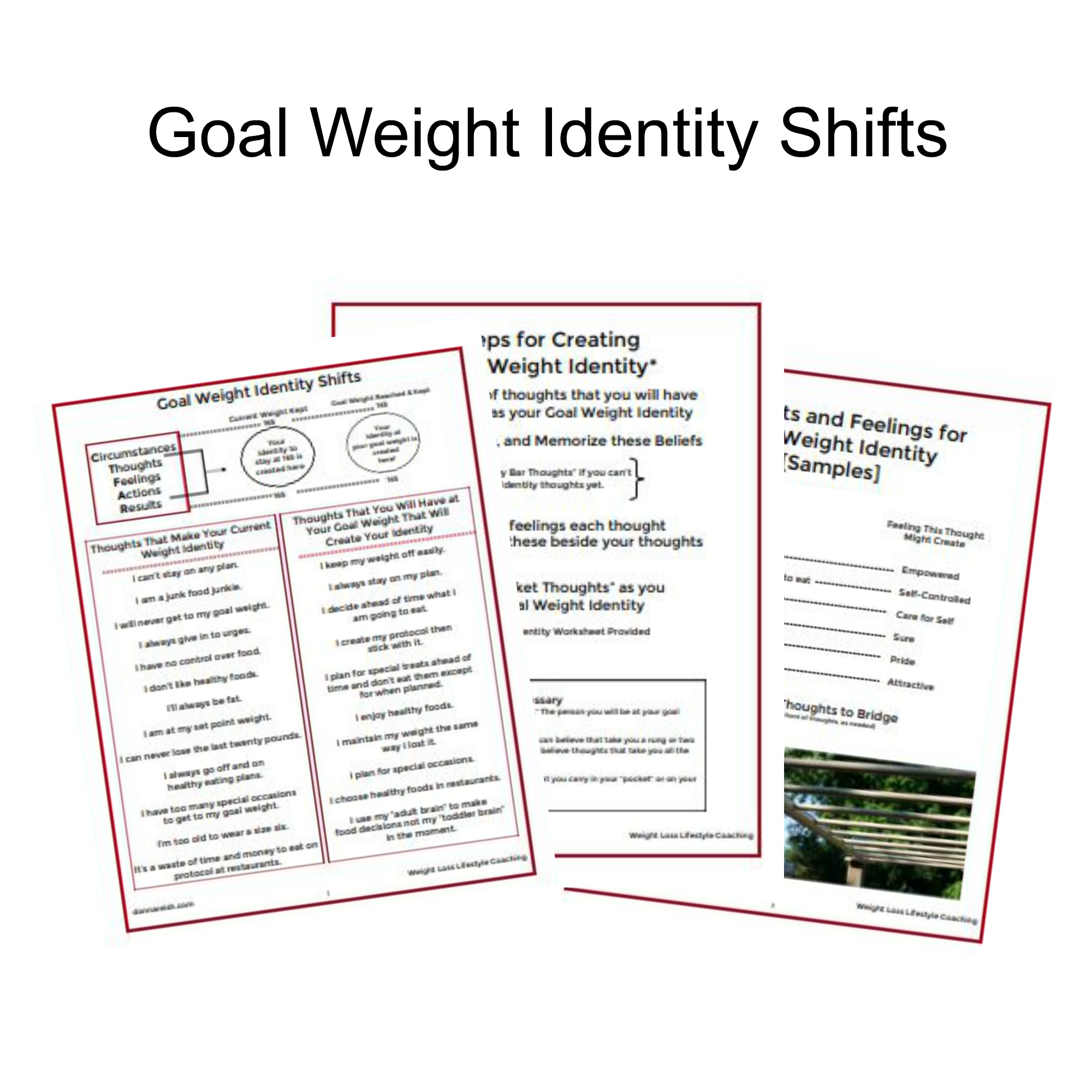
I am continuing last week’s intro to Goal Weight Identity (TFE 23), taking listeners and viewers through my freebie packet (Goal Weight Identity Packet) to change current, less-serving Thoughts to the new Thoughts we will have once we are at our goal weight.
But how do we do that? We can’t believe we are a size six, only eat sugar on pre-determined very special occasions, weigh our goal weight, and wear sleeveless dresses anytime we want right now—we can’t simply say those things and make them be so.
And that is where “Monkey Bar Thoughts” (i.e. Ladder thoughts) help us. In the Goal Weight Identity Packet, I teach how to use future thoughts with some modifiers/degree words to make you believe them right now! (How Language Arts Lady of me, huh?)
We might not be ready to go completely across the monkey bars to the Thought we will have when we are at our goal weight—but we can go across the Monkey Bars with helping words.
Remember, our Thoughts lead to our Feelings. Our Feelings lead to our Actions. If we Think our new identity—the identity we will have when we are at our goal weight—we will start Acting like that new person!
Think-Feel-Eat…Think-Feel-Act….words, thoughts, feelings….they all matter in our weight loss journey!
Find all of my episodes, outlines, and articles for my two weekly broadcasts:
(1) Weight Loss Lifestyle broadcast (formerly Donna’s Intermittent Fasting Broadcast)
Sign up for my free webinar: https://intermittentfastingwebinar.com

Think Feel Eat 24 Outline Our Goal Weight Identity Part II (of II)
A. Introduction
1. What we are doing at the end of our journey is what we will do to stay there…
2. Think-Feel-Act
a. We act on what we feel
b. We feel from what we think
c. Last week’s example of how we treat someone who is late based on what we think (She ruins the meetings by coming late; she is late again because her husband is terminally ill.)
3. New Identity
a. We take on a new identity when we become something we previously were not (i.e. just got married; just had a baby; just got a different job—we become that new identity—we think like it, feel like it, and act like it)
b. Goal Weight Identity Thoughts
4. Previous episodes
B. Goal Weight Identity Packet—Get Yours Here!
1. Walk through it
2. Thoughts that we have at our weight now—what thoughts keep us at this weight
3. Thoughts we will have at our new weight
4. Monkey bar thoughts
5. Let yourself dream a little—Sophi and her “tada” potty training
C. Get More Help!
1. Intermittent Fasting Course—first Monday of each month; use code SAVE20 to get $20 off
3. Perfect Storm of Weight Loss


Think-Feel-Eat Episode #23: Goal Weight Identity Part I (of II)
Hi! I’m Donna Reish, IF teacher, weight loss coach, blogger, and half of “The Minus 220 Pound Pair” as my husband and I have lost over 220 pounds together (160 of that in the past couple of years through the Perfect Storm of Weight Loss habits and strategies I teach!).
In this episode, I present Part I of II of our Goal Weight Identity.
When we want to become something new, we have many steps to take…..
We often plan on the doing steps. In the case of losing weight, this often means foods, workouts, plans, etc.
But one thing we need to spend more time on than we do is becoming that new person RIGHT now in our Thoughts.
So in this Think-Feel-Episode, I’m going to introduce how to do this—how to develop our new Goal Weight Identity.
I begin by re-introducing the Think-Feel-Act cycle with an example we can all relate to—that we Feel and then we take Actions towards people based on what we Think about them. (This example is one in which we can clearly see—Yes! I do Act based on how I FEEL about someone!)
Then I describe how this relates to our Goal Weight Identity and how we view ourselves. If we view ourselves as someone who weighs our goal weight and wears the size we desire, we take Actions aligned with that belief.
On the other hand, if we view ourselves as someone who can’t lose weight or wear a smaller size, we take Actions that keep us right there.
I use some material from a book called What to Say When You Talk to Yourself to expound on how our brains believe anything we tell them!
Then we move into the big picture of Goal Weight Identity, including what it is, I AM thoughts, identifying as someone who struggles with weight, becoming aware of what we are doing, and more.
This episode can help you with any GOAL—time management (helping my time clients soooo much!), business, exercise, relationship, weight, and more!
Find all of my episodes, outlines, and articles for my two weekly broadcasts:
(1) Weight Loss Lifestyle broadcast (formerly Donna’s Intermittent Fasting Broadcast)
Sign up for my free webinar: intermittentfastingwebinar.com

A. Introducing Think -Feel-Act
1. Coaching, coaching, and self-development framework
a. We Think a thought that causes us to Feel a feeling—and that feeling leads to our taking Actions that help us reach our goals
b. Brooke Castillo’s Self-Coaching Model was designed with the Think Feel Act cycle in the middle of it
i. CTFAR
ii. Circumstance; Thought; Feeling; Actions; Result
c. We can pull out the Think-Feel-Act (or in our case here, the Think-Feel-Eat) portions and see what our Thoughts are causing us to Feel and how that Feeling is causing us to Act.
2. Example in real life
a. Someone who is always late
b. One TFA Cycle
i. Think: She ruins the meetings by arriving late all the time
ii. Feel: Angry (or Inpatient or Unloving)
iii. Act: Many actions like ignoring her, not listening to her ideas, being hostile towards her
c. Second TFA Cycle
i. Think: She is late because her husband is terminally ill
ii. Feel: Empathy
iii. Act: Many actions like including her, greeting her at the door, saving her a seat, encouraging her idea, seeing her out
B. Look at the Difference Between the Old Model and the New Model
a. Old model has the result of current weight; new model has the result of new weight
b. Right now our brain is firing with the neuroconnections, peptides, hormones, etc. based on our current thoughts
i. These thoughts give us the feelings we now have at our current weight
ii. We must make the current neuro-connectors stop firing with new thoughts
C. The Brain Doesn’t Know Reality From What You Tell It
1. Book: What to Say When You Talk to Yourself
2. This is why kids believe what they are told over and over again about themselves even if it’s not true (and so do adults)
3. When our thoughts match our feelings, we will act
4. Told my daughter she was the best—kids usually believe what they repeatedly hear
D. New Version—Big Picture: We Must Create a New Identity for Ourselves
1. Changing a behavior without changing thoughts is not sustainable
2. Identity defined
a. Collection of thoughts we have about ourselves
b. AND how we think other people see us
3. Especially change I AM thoughts…..these are the basis of our identity
a. They are the bars that we create our cage with
b. They aren’t true, but by using the words I AM, we honestly think they are true
c. I am thoughts become unchangeable to us.
d. We can choose to think whatever we want to think!
4. Stop identifying as someone who struggles with weight
a. We are not “addicted to processed foods”
b. We just don’t want to feel feelings that we have without processed foods
5. We make the current neuro connectors stop firing when we do the following
a. Become aware
b. Get rid of old thoughts
c. Replace old thoughts with new ones
d. Create new neuropathways
6. Awareness (first step)
a. When we know we are thinking a thought that isn’t helpful, this is awareness…the first step
b. We can become so aware that we dismiss the thought before we ever think it
i. Example: know we always think something when we see pics of ourselves
ii. Example: know we always say this to ourselves when we look in a mirror
E. Application
1. First step is awareness—we have to be aware that our existing thoughts will not generate the feelings that we need to get to our goal weight (and stay there)
2. Once we see that these thoughts need changed, we can work on changing them to get the feeling we do need.
3. This works in every area of life that we want to improve—time management, relationships, business, weight, exercise, etc.
F. Additional Helps
1. Free IF Webinar: intermittentfastingwebinar.com


Think-Feel-Eat Episode #22: The DAILY Ahead of Time Decision That Makes All the Difference for Weight Loss
Hi! I’m Donna Reish, IF teacher, weight loss coach, blogger, and half of “The Minus 220 Pound Pair” as my husband and I have lost over 220 pounds together (160 of that in the past couple of years through the Weight Loss Lifestyle habits and strategies I teach!).
Deciding Ahead of Time could be THE single biggest factor in weight loss. Why? Because when we decide ahead of time, we are using our pre-frontal cortex, the part of our brain that thinks logically, decides ahead of time, wants the best for us, can plan and execute, and more.
In this week’s broadcast, I describe the power of Deciding Ahead of time in general—how we have used this in parenting from toddlers to young adults with amazing results. And how we now apply it to our food and movement.
Research shows that we spend four hours a day resisting temptations and have up to 120 food-related decisions a day. We simply don’t have the willpower for that! Thus, we have a willpower gap. (See Weight Loss Lifestyle #60 and #61 for the details to willpower, how to get more, how to conserve what we have, how to utilize it to its maximum, what to do instead of willpower, and more!)
We need willpower (or something better—read on!) to overcome two big issues with weight loss and weight management—over-desire and over-hunger (which lead to over-eating in both instances).
Deciding ahead of time what we will eat each day is the answer! That is, we can use our pre-frontal cortex to decide WHEN we will eat, WHAT we will eat, and the AMOUNT we will eat—ahead of time! (See The Perfect Storm of Weight Loss for more help in determining the best food protocol for YOU!)
Listen and learn—and apply this knowledge to your own weight loss or weight management approach. It will change your life!
Get your free journal sheet for your Decide Ahead of time daily food choices here.
Find all of my episodes, outlines, and articles for my two weekly broadcasts:
(1) Weight Loss Lifestyle broadcast (formerly Donna’s Intermittent Fasting Broadcast)
Sign up for my free webinar: intermittentfastingwebinar.com

A. Episode 22: The One BIG Decision You Need to Make Ahead of Time
1. What foods you are going to eat 80% of the time—your go to food list
2. Food version of abstinence like AA, etc.
3. Pick a Protocol is what protocol you will eat (TFE 16, 17, and 18)
a. Helpful for narrowing down the types of foods you will eat in order to create your caloric deficit and eat the amount you need for your future sized body.
b. Quick review….get your Pick-a-Protocol packet here
c. Review of the Helpful Foods Lists (download here!)
d. Can use any protocol that fits The Perfect Storm of Weight Loss
i. Pillar One: Food Decided Ahead—Food Type, Food Amount, Food Time
ii. Pillar Two: Hormones and Neuro-Transmitters/Brain Chemicals (causing cravings, causing depression or motivation, etc. )
iii. Pillar Three: Thoughts and Emotions Management
B. Willpower Review—Weight Loss Lifestyle 60 and 61
1. Willpower research
a. Found that we spend four hours per day resisting temptations
b. Other experiments (M and M’s on table vs across the room—barriers!) and how much “brain power” they had left for intense tasks
c. Brian Wansink (researcher) has shown that we make 119 food-related decisions each day
2. We Have a Willpower Gap
a. Willpower gap means that we don’t have enough willpower left to overcome the urges that we are presented with
b. Willpower drains and depletes from all kinds of decisions and actions
3. Why we couldn’t lose weight before
a. We didn’t know that the amount, type, and intensity of WILLPOWER needed to lose weight were nearly impossible to sustain when it comes to food urges.
b. Leaves the weight of the changes on the part of the brain that is ill-equipped to make those decisions and carry the burden of saying no
4. It takes willpower to resist (or sit with) over hunger and over desire
a. Over hunger—hunger signals, grehlin tells us we are empty; leptin tells us we are full
b. Over desire—processed foods, frequent eating, sugar and flour concentrations, not real foods all lead to overdesire due to neuro transmitters in the brain that tell us we want more and more of those things each time we have them (dopamine and serotonin)
5. Ways we handle willpower ineffectively
a. Eating several small meals a day
b. White knuckling and resisting
c. Eating whatever we want but “counting” (we are eating foods that are too hard to control)
6. Ways to refill our willpower stores
a. Sleep
b. Conection
c. Prayer
d. Meditation
e. Gratitude
f. Self care
7. IF Helps With Willpower
8. Automaticity Helps With Willpower
9. Reduce Six Seductive Craving Combinations helps with willpower
C. Decisions Ahead of Time
1. Pre-frontal cortex
a. Unaffected by emotions, willpower, cravings, etc.
b. The planning part of our brain
c. The part that has our best interest in mind
d. The part that cares about our future self
2. Decisions in the moment are made with our primal brain
a. Avoid discomfort
b. Seek happiness and immediate gratification
c. Toddler brain
3. Studies showing we always PLAN to eat better ahead of time—the cake vs. fruit order
a. We always think we can do it when we are planning next week
b. Use this “decide ahead of time” strength to our benefit
4. Decide ahead of time! (Free Journal Sheet!)
a. Decide today WHEN you will eat tomorrow
b. Decide today WHAT you will eat tomorrow (watch for upcoming Protocol Planning broadcasts!)
c. Uses your pre-frontal cortex (adult brain) not toddler brain
d. Uses less willpower since it is decided when you are not in the heat of the moment
D. Work on Your Own Perfect Storm of Weight Loss!
1. Get free journal sheet to Decide Ahead of Time what you will eat each day (1-3 minute process!)
2. Follow the Perfect Storm steps!
3. Schedule a free consult to see if one-on-one coaching is right for you!


Think-Feel-Eat Episode #21: One BIG Decision to Make Ahead of Time
Hi! I’m Donna Reish, IF teacher, weight loss coach, blogger, and half of “The Minus 220 Pound Pair” as my husband and I have lost over 220 pounds together (160 of that in the past couple of years through the Weight Loss Lifestyle habits and strategies I teach!).
We need to make a lot of decisions in order to lose weight and maintain our loss.
(Oh, the decisions that have gone into my husband and my 220 pounds-together weight loss—and the decisions we have to continually make in order to maintain it! Seriously hard work!)
And the best decisions for weight loss are those that we make ahead of time. (You can find out why when you watch or listen to my extensive willpower episodes—WLL 60 and 61!)
But there is one BIG decision we need to make ahead of time…okay there is more than one.
First, we have to make a decision to follow a lifestyle that will lead us to our goal (such as The Perfect Storm of Weight Loss).
Then within that we will decide our Food Protocol:
1. What times we will eat
2. What food we will eat
3. What amounts we will eat
(These are the first pillar of the Perfect Storm.)
Then once we know our food protocol—the boundaries we have made for ourselves, then we are ready for this BIG one…
What foods will make up 80% of our eating.
These will be foods that are on our protocol, that help with the other aspects of the perfect storm, AND that we enjoy.
So in today’s episode, I give you a great resource for you to start creating your “this is what I eat 80% of the time” list.
And I teach you more about real foods. And dopamine spikes. And cravings. And deciding ahead of time. And staying on protocol—-all the stuff!
(For more about self-integrity and deciding ahead of time, watch/listen to Think Feel Eat 19 (Enemies of Self-Integrity) and 20 (Tools for Self-Integrity).)
Starting with this BIG decision ahead of time, having a food list of what you eat, you will have this hard decision made ahead of time 80% of the time. (The other 20% you’ll plan your Fun Foods—and those will be, well, fun!)
So download your Helpful Food Lists document here!! And make this BIG decision now—ahead of time…not in the moment!
Find all of my episodes, outlines, and articles for my two weekly broadcasts:
(1) Weight Loss Lifestyle broadcast (formerly Donna’s Intermittent Fasting Broadcast)
Sign up for my free webinar: https://intermittentfastingwebinar.com


Think Feel Eat Outline 21 One Big Food Decision You Must Make Ahead of Time
A. Pick-a-Protocol
1. Helpful for narrowing down the types of foods you will eat in order to create your caloric deficit and eat the amount you need for your future sized body.
2. Quick review….get your Pick-a-Protocol packet here
3. Can use any protocol that fits The Perfect Storm of Weight Loss
a. Pillar One: Food Decided Ahead—Food Type, Food Amount, Food Time
b. Pillar Two: Hormones and Neuro-Transmitters/Brain Chemicals (causing cravings, causing depression or motivation, etc. )
c. Pillar Three: Thoughts and Emotions Management
B. Decisions Ahead of Time
1. Pre-frontal cortex
a. Unaffected by emotions, willpower, cravings, etc.
b. The planning part of our brain
c. The part that has our best interest in mind
d. The part that cares about our future self
2. Decisions in the moment are made with our primal brain
a. Avoid discomfort
b. Seek happiness and immediate gratification
c. Toddler brain
C. One Big Food Decision You Need to Make Ahead of Time
1. Already decided your protocol (TFE 16, 17, and 18)
2. Now decide the foods you will eat (on that protocol) 80% of the time
3. A ready-made food list of foods you like that help you with your Perfect Storm of Weight Loss
4. Review of the Helpful Foods Lists (download here!)


Think-Feel-Eat #20: Tools for Self-Integrity (Part II of II)
Hi! I’m Donna Reish, IF teacher, weight loss coach, blogger, and half of “The Minus 220 Pound Pair” as my husband and I have lost over 220 pounds together (160 of that in the past couple of years through the Weight Loss Lifestyle habits and strategies I teach!).
Self-Integrity is at the basis of every change we want in our lives—physically, mentally, emotionally, relationally, spiritually, productively….it is the core to why we don’t do what we say we will do—and why we do, do what we say we will do!
Most of us call self-integrity by another name: willpower. We think we just don’t have the willpower to do what we tell ourselves we will do.
And there’s some truth to the fact that we often don’t have the willpower to carry out what we say we will do….but willpower isn’t the only cause of our self-integrity lack.
Last week, in Episode #19 of Think-Feel-Eat, I described a few enemies of self-integrity (what we make past failures mean; perfectionism; not breaking things down {habit formation skills lacking}; relying on willpower; and not deciding ahead of time).
(For more understanding of willpower, see my Weight Loss Lifestyle broadcasts #60 and #61.)
In this week’s episode, I bring good news! Tools!
Tools we can use in our lives and skills we can develop to become the kind of person is filled with self-integrity—the kind of person who does what we say we will do. Yay us!
These tools counteract the enemies of self-integrity and put us on the path to food control, business growth, daily disciplines, relationship nurturing, and much more.
I present a few general tools like Thought Work, sleep, automaticity, and craving reducers.
Then I have created a derivative of BJ Fogg’s (Tiny Habits) ABC’s of Habit Formation by combining his ABC, my experience with attachments and minimum baselines through homeschooling for thirty-two years, and an early teacher (Gregg Harris) in the homeschooling world’s Attachment Approach (Fogg calls this Anchor). This tool works—and I am so excited to present it to you!

20 Self Integrity Part II of II (Tools for Self Integrity—Including the ABC Approach!)
A. Review Why We Don’t Do What We Tell Ourselves We Will Do
1. Past failures—what we make them mean
2. Perfectionism
3. Not breaking things down (habit formation)
4. Relying on willpower (Weight Loss Lifestyle 60 and 61)
5. Not deciding ahead of time (today’s tools will help this!)
B. Misc. Tools That Will Make a Difference!
1. Thoughts (Perfect Storm #7)
2. Sleep can refill willpower stores (Weight Loss Lifestyle 42)
3. Automaticity
a. Schedules
b. Repeating same foods
4. Reducing cravings
a. TFE 7, 8, and 9
b. Extend the time between super seductive foods
C. The ABC’s of Self-Integrity
1. Three little steps that the above enemies of self-integrity often diminish
2. Questions/ABC aspect from BJ Fogg Tiny Habits book
3. My introduction to the first two steps from Gregg Harris in The Advanced Homeschooling Workshop
4. The C—Celebration
a. Many used to say that this was actually “Consequences”—the outcome of doing A and B.
b. Researchers now believe that it isn’t the outcome that drives us to create habits and to stay in self integrity
c. We are driven to change behaviors through Feelings
i. Celebration (step three) intensifies and emphasizes positive feelings related to our self integrity
ii. Celebration gives us a built in opportunity to feel the feeling that will help us to continue to build that habit/be in self integrity

D. Get More Help!
1. The Perfect Storm of Weight Loss teaches the steps to create your own protocol and bring together all aspects of weight loss
2. Willpower Part I and II
3. Intermittentfastingcourse.com
4. Sign up for a free consult call to see if weigh/time management/life coaching with me would help you meet your goals! Donnareish.com/coachingpackages
5. Pick-a-Protocol 16, 17, and 18


Categories
Plexus
Check out the supplements that have changed my life!
Ray & Donna Reish Independent Ambassadors #1382677

Contact Me!
Character Ink Press
Downloadable lessons, Language Arts curriculum, Character Training tools & more!
Plexus
Check out the supplements that have changed my life!
Ray & Donna Reish Independent Ambassadors #1382677
